
No. 17 of Returning Home (Reignited)
After receiving an explanation from Judah’s leaders, Tattenai wrote to King Darius to confirm what the people of Judah had told him.
This is a copy of the letter that Tattenai the governor of the province Beyond the River and Shethar-bozenai and his associates, the governors who were in the province Beyond the River, sent to Darius the king. 7 They sent him a report, in which was written as follows: – Ezra 5:6-7
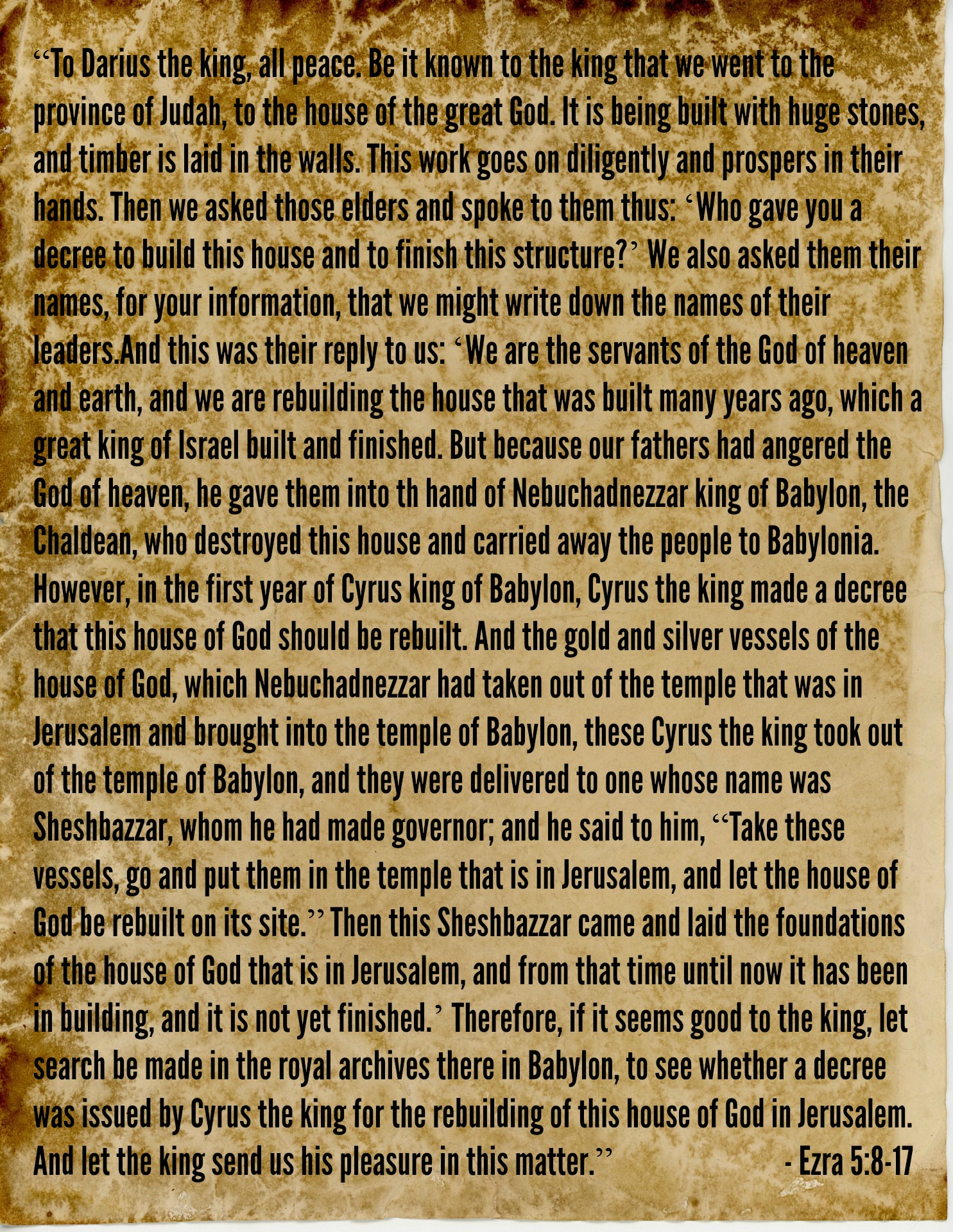
The leaders building the temple explain that Sheshbazzar, also known as Zerubbabel, had been appointed by Cyrus the Great, and that this appointment would be confirmed by the records in the king’s archives. These leaders of God give Tattenai a complete explanation, including the punishment that “the God of heaven and earth” placed upon their fathers when Nebuchadnezzar took them away into captivity. Imagine telling this to the world leaders of our day! Would they accept the truth of a God of heaven and earth who punishes nations for disobeying Him?
Darius has his subjects scour the past records for proof that Cyrus had commissioned the rebuilding of the temple at Judah.
“Then Darius the king made a decree, and search was made in Babylonia, in the house of the archives where the documents were stored. 2 And in Ecbatana, the citadel that is in the province of Media, a scroll was found…” – Ezra 6:1-2a(ESV)
The scroll of Cyrus’ decree is found at Ecbatana (also called Achmetha), which today is known as Hamadan. The capital of the Median Empire under Astyages, the last king of the Medes, was Ecbatana. Cyrus, the first king of the Persian empire, conquered the Medes and took the palace at Ecbatana in 550BCE. In 539BCE he conquered Babylon and made Pasargadae his capital city, but Ecbatana was still used as his summer residence. When Darius the Great came to power, he made the capital city Ecbatana once more. Finding the records at Ecbatana is a detail that agrees with historical accounts of Cyrus’ and Darius’ whereabouts.
Darius I, like Cyrus, preferred to make peace with the gods of the nations he ruled. A letter sent to one of Darius’ subjects, Gadatas, depicts his tendency to honor the gods of lands. While scholars question the authenticity of the letter itself, its message is considered characteristic of Darius’ political stance to guard and protect the religious rights of the nations in order to promote good rapport among the many peoples he controlled.

The King of Kings, Darius, son of Hystaspes, speaks as follows to (his) slave Gadatas: I learn that you are not obedient to my commands in all respects. Inasmuch as you are working to improve my land, transplanting the fruits (of the territory) beyond the Euphrates to the lower parts of Asia, I praise your purpose and because of this great thanks will be in store for you in (the) King’s House. But inasmuch as you are setting at naught my disposition about the gods, I shall – if you do not change (your behaviour) – give you a taste of wronged anger. For you exacted tribute from Apollo’s sacred gardeners and ordered (them) to dig profane land, heedless of the attitude of my ancestors towards the god who spoke every exactitude to (the) Persians…1
Darius informs Tattenai that the men of Judah are telling the truth.
…a scroll was found on which this was written: “A record. 3 In the first year of Cyrus the king, Cyrus the king issued a decree: Concerning the house of God at Jerusalem, let the house be rebuilt, the place where sacrifices were offered, and let its foundations be retained. Its height shall be sixty cubits and its breadth sixty cubits, 4 with three layers of great stones and one layer of timber. Let the cost be paid from the royal treasury. 5 And also let the gold and silver vessels of the house of God, which Nebuchadnezzar took out of the temple that is in Jerusalem and brought to Babylon, be restored and brought back to the temple that is in Jerusalem, each to its place. You shall put them in the house of God.” – Ezra 6:2b-5(ESV)
Cyrus’ decree, also found in 2 Chronicles 36:23 and Ezra 1:2-11, is here triplicated. Darius informs Tattenai that Cyrus included architectural specifications regarding the size and materials of the structure. All the facts are in: the men of Judah are within their rights to build the temple. But Darius isn’t finished with his instructions to Tattenai.
I am really enjoying this series. You make this part of the Old Testament very much plainer to me than anything else I’ve read before. Thank you for the study and research you have done!
Studying it this way makes it plainer to me, too. Thanks for your encouragement!