No. 7 in Returning Home
Genesis 3 gives the first instructions about sacrificing to God with an account of what not to do. Cain, a tiller of the ground, decides to offer something that is not acceptable to God and gets angry when his Creator refuses it. God attempts to reason with Cain, telling him, “If you do well, will you not be accepted?” (Genesis 4:7ESV). Cain had not done well in his offering, and he knew it. Instead of choosing to obey God, Cain chooses to get rid of the one whose offering was approved. In essence, Abel’s good sacrifice created a comparison that exposed the inferior nature of Cain’s offering.
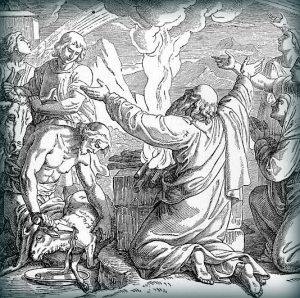 Noah builds an altar of thanksgiving to God, and God honors it by giving Noah and his descendants a promise that He will never flood the earth again. He seals His promise with the token of the rainbow (Genesis 9:13ESV). Abraham, Isaac, and Jacob give sacrifices to God; they offer animals on the altar in faith that God will keep His promise to give them Canaan and a great nation in whom all the nations of the earth would be blessed (Genesis 17:5-8ESV). God commands Abraham and his offspring to be circumcised as a token of His promise (Genesis 17:11ESV).
The token of circumcision continues with Moses and the law he delivers to Israel. When the priests of the tabernacle and, later, the temple are instructed in the offerings that are acceptable to Jehovah God, each offering contains a specific meaning and must be carried out in an appointed way. The blood of unblemished animals flows out in revolting abundance in the books following. God does not delight in these bloody sacrifices. These represent an image of what atonement for sin looks like. It is the very ugliness of blood and death that God wants His people to relate to their sin. He abhors sin. He rejects it, just as it is our instinct to turn our faces from the sight of such bloodshed. He was preparing His people to understand how heinous to Him the crucifixion would be. That moment in time is the forever sacrifice when the God-man, Jesus the perfect and pure Son, was hung to bleed out on a Roman cross. Looking back from the cross side, it is no wonder that our God gave the Levites detailed instructions to worship Him acceptably. Symbolically, He was showing them how to reenact an event in the future.
Also, of the sons of the priests: the sons of Habaiah, the sons of Hakkoz, and the sons of Barzillai (who had taken a wife from the daughters of Barzillai the Gileadite, and was called by their name). These sought their registration among those enrolled in the genealogies, but they were not found there, and so they were excluded from the priesthood as unclean. The governor told them that they were not to partake of the most holy food, until there should be a priest to consult Urim and Thummim. – Ezra 2:61-63(ESV)
Ezra records the unclean Levites who could not administer the sacrifices of God. These priests were still part of the body of Israel, but they were removed from taking part in the priestly duties. By law, the families of the Levite priests were fed by the sacrifices that were offered, but there was concern that these Levites who had married outside of the bloodline might not be acceptable to God even to eat of the food of the temple. God is applied to for guidance using the Urim and Thummim. Urim means “lights” and Thummim (Tummim) means “perfections.” The terms Urim and Thummim applied to the precious stones that represented the twelve tribes of Israel. These stones were placed on the Ephod, or breastplate, that Aaron the high priest wore over his heart (Exodus 28:29-30ESV).
God does not have any scribe of His reveal how the Urim and Thummim helped the priests ask God and be granted His answer. Even the details of the furnishings and practices of the tabernacle and the temple were directly authorized by God through His instructions given to the builder or priest, who gave the directions to those working with him (Exodus 35:30-36:2ESV). In this way, God is the sole Author of absolute permission and instruction. Without Him the true temple could not be rebuilt. He has never been interested in replicas or lookalikes; only worship that is God-authorized will do.
When He instructed Cain to do well, He wanted Cain’s true sacrifice because He was seeing His only Son on the cross as He spoke with that disobedient brother. He wants our true sacrifice today: a clean, purified life offered to Him. When we accept Christ’s covenant by offering up our lives to the Father, He makes us His children and heirs of His promise. He promises us eternal life, and the token of His promise is still circumcision. It is the circumcision of the heart, which He performs when we are buried with His Son in baptism (Colossians 2:11-12ESV and Romans 2:28-29NKJV).
There are still Cains who want to present God with unclean offerings. Just like the unclean priests of Ezra’s time, they will present themselves among God’s people. Just as the unclean priests were not accepted to perform the worship to God, those of today will not be accepted into Christ’s “royal priesthood” (I Peter 2:9ESV). Like Abel, Christians may face the wrath of our Cain-like brothers and sisters because they choose not to give a true sacrifice. Like Abel, Christians’ good sacrifices expose the bad ones. (The apostle Paul says a Christian’s sanctified life stands as a judgement on the world – I Corinthians 6:2ESV.) Instead of accepting every one who says they are of the priesthood, Christians must be like the governor and the priests in the book of Ezra and consult the “light” of God’s word (2 Peter 1:19ESV), the “perfect” law of liberty (James 1:25ESV) to know what God does not accept. May you always be guided by His truth.